
Flowers
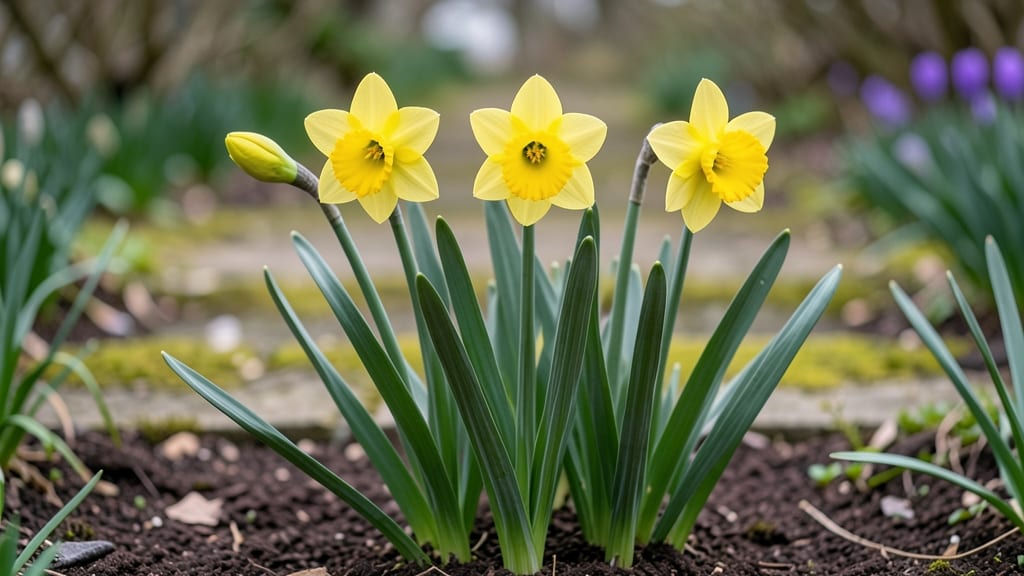
Daffodils are perennials that return yearly, dying back to the ground in summer but storing energy in their bulbs for spring regrowth. Their hardy nature ensures they thrive across multiple seasons with minimal care.
Daffodils prove their perennial status through a clever survival strategy: they retreat underground during summer's heat rather than fading forever. 🌱 This dormancy phase isn't weakness—it's how they conserve energy in their bulbs, preparing for next year's vibrant blooms.
Unlike annuals that complete their life cycle in one season, daffodils build resilience through each cycle, often lasting decades with proper care.
What makes this cycle fascinating is how environmental cues trigger their regrowth. Cool autumn temperatures and shortening daylight hours signal the bulbs to wake up, while consistent moisture during early spring ensures strong shoots. This biological clock explains why daffodils often emerge through snow—nature's timing mechanism is remarkably precise.
💡 In This Article
- Daffodil Life Cycle: Why They Die Back and Regrow
- Caring for Daffodils Through Their Perennial Stages
Daffodil life cycle: why they die back and regrow
Daffodils employ a sophisticated survival mechanism called dormancy, where they intentionally shut down growth during summer's heat. This isn't laziness—it's a protective adaptation. Their bulbs, which can weigh up to 2 ounces for mature plants, store carbohydrates like starch and sugars in specialized cells.
These energy reserves fuel regrowth when conditions improve. 🌱 The bulb's outer layers act like insulation, preventing moisture loss while maintaining vital internal processes.
The regrowth trigger is a biological puzzle involving three key factors: temperature, daylight duration, and moisture. When autumn temperatures drop below 60°F and daylight shrinks to 12 hours or less, the bulbs receive the signal to break dormancy.
This photoperiod sensitivity explains why daffodils often bloom earlier than other perennials—they're tuned to nature's calendar. The bulb's growing point (meristem) begins dividing cells rapidly, pushing up shoots when soil temperatures reach 50-55°F.
What's remarkable is how daffodils prioritize energy storage over immediate growth. During their active spring/summer phase, they allocate 60-70% of photosynthesis energy to bulb expansion rather than flower production. This explains why their foliage stays green long after blooming—it's powering next year's show.
Unlike annuals that die after flowering, daffodils continue photosynthesizing until frost, building a 2-3 year supply of nutrients in their bulbs.
The dieback phase isn't random—it's a calculated energy conservation strategy. When summer temperatures exceed 85°F, the bulbs enter true dormancy, halting all growth processes. This prevents moisture loss through transpiration while maintaining just enough metabolic activity to stay viable.
The brown foliage you see isn't dead—it's actively transporting nutrients back to the bulb through a process called senescence, which can take 6-8 weeks to complete.
This life cycle creates a fascinating contrast with annuals. While a marigold completes its entire life in one season, a daffodil bulb might live for 20+ years if undisturbed. The bulb's layered structure—with protective scales surrounding the growing point—acts like a natural time capsule.
Each layer represents a year's growth, with the oldest at the center and newest on the outside. This concentric growth pattern is why daffodils can produce multiple stems from a single bulb.
Consider this: a daffodil bulb planted in October 2023 might not bloom until spring 2025 because it needs two growing seasons to establish sufficient energy reserves. This delayed gratification is part of their perennial genius—building resilience through each cycle rather than relying on annual reproduction.
The trade-off? Their first blooms are often smaller as the plant invests in bulb development rather than flower production. 💫