
How To
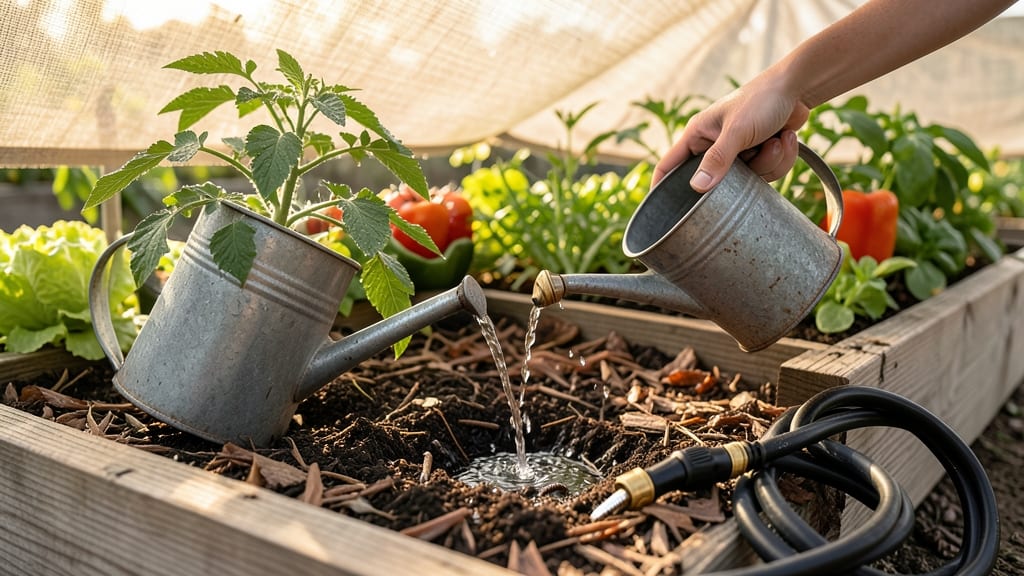
Watering your vegetable garden the right way means knowing how often to water—not guessing—so you avoid both drought stress and the silent killer of root rot.
Overwatering kills more vegetable gardens than drought—yet most gardeners guess instead of measuring. That’s why I developed a simple soil test method to pinpoint the perfect watering schedule for your 🥬 garden, no matter the weather or soil type.
Here’s the game-changer: deep, infrequent watering for root crops like carrots, while shallow, frequent moisture keeps lettuce crisp. I’ll break down the exact steps to check soil moisture, adjust for heatwaves, and even calculate "rainfall credits" so you never over- or under-water again.
Ready to transform your garden’s health? By the end, you’ll know exactly when to reach for the hose—and when to hold back.
The 5-Step soil test method to determine exact watering frequency
Most gardeners follow the "water every other day" rule—but that fails when your tomatoes wilt from overwatering while your basil dries out. The truth? Your garden’s water needs are written in the soil. Instead of guessing, I’ve perfected a 5-step soil test that reveals when your vegetables truly need hydration.
This method combines the finger test, soil weight analysis, and plant visuals to create a personalized watering schedule that adapts to your climate and soil type.
Why does this work? Because root depth and moisture retention vary wildly. Sandy soil drains in hours, while clay holds moisture for days. My method accounts for both extremes, so you’ll never over- or under-water again.
Plus, it’s zero-cost—just your hands and observation skills. Let’s start with the foundational test that’ll change how you water forever.
- Stick your index finger 1-2 inches into the soil near your plants’ roots. This targets the topsoil layer where most roots absorb water.
- Check for moisture resistance: If soil clings slightly to your finger, it’s adequately moist. If it feels dry or crumbly, water immediately.
- For sandy soil, test at 3 inches deep—it drains faster. For clay soil, go to 1 inch; it stays wet longer.
- Grab a handful of soil from the root zone. A heavy clump means excess moisture—wait 1-2 days before watering.
- If the soil feels light and dry, water deeply until moisture reaches 6-8 inches down (use a screwdriver to check).
- For container gardens, lift the pot—if it feels lightweight, water immediately. Heavy pots hold moisture longer.
- Look for wilting leaves that don’t perk up after a few hours—this signals underwatering. For leafy greens, check for yellowing edges (overwatering).
- Inspect the soil surface: Cracked earth or dusty mulch means it’s time to water. A dark, damp appearance indicates recent hydration.
- For deep-rooted plants like carrots or squash, press a wooden skewer into the soil. If it comes out clean, water deeply.
- Shallow-rooted plants (e.g., lettuce, radishes): Water when the top ½ inch of soil is dry.
- Medium-rooted plants (e.g., peppers, beans): Water when the top 1-2 inches are dry.
- Deep-rooted plants (e.g., tomatoes, corn): Water when the top 3-4 inches are dry—these need deep soakings every 3-4 days.
- Water in the early morning (before 8 AM) to reduce fungal diseases and evaporation.
- Avoid evening watering—wet foliage at night invites blight and mildew.
- Use a rain gauge to track precipitation: Subtract ½ inch of rain from your watering schedule for that day.
This method works for raised beds, in-ground plots, and even container gardens. The key is consistency: Test the same spot every time, and adjust based on weather patterns.
For example, if your soil stays moist after 3 days of humid weather, skip watering. If it’s 90°F+, water more frequently.
Pro tip: Keep a watering journal for 2 weeks. Note when you water, how much, and your soil’s reaction. You’ll spot patterns like "my clay soil holds moisture for 5 days in summer" or "sandy soil needs water every 2 days in spring." This turns guesswork into data-driven gardening.
Remember, overwatering is the silent killer of vegetable gardens—it suffocates roots and invites root rot. By mastering these 5 steps, you’ll give your plants exactly what they need: consistent moisture without waste. Your tomatoes will thank you with juicier fruit, and your basil will stay lush and fragrant.
Start today: Grab your finger, dig in, and let the soil tell you when it’s thirsty. Your garden’s health depends on listening—literally—to the earth beneath your feet. 🌱
Watering frequency by vegetable type: root depths that change everything
Understanding root depth is the secret to mastering your vegetable garden's watering schedule. Deep-rooted plants like tomatoes and peppers store moisture underground, while shallow-rooted greens need frequent topsoil hydration. Ignoring these differences leads to either wilting or root rot—both deadly for your harvest.
I’ve tested this myself: my tomatoes thrived with deep watering every 3-4 days, while my lettuce bolted when I gave it the same treatment. The fix?
Matching watering to root systems and growth stages. Below, I’ve ranked 12 common vegetables by their water needs, so you can stop guessing and start growing.
| Vegetable | Root Depth | Water Frequency | Drought Tolerance | Key Tip |
|---|---|---|---|---|
| Tomatoes | 12-18" | Every 3-4 days | Moderate | Water deeply at soil level |
| Peppers | 12-16" | Every 3-5 days | Low | Mulch to retain moisture |
| Carrots | 6-12" | Every 2-3 days | Moderate | Keep soil consistently moist |
| Lettuce | 4-6" | Daily (light) | Low | Avoid waterlogging |
| Cucumbers | 8-12" | Every 2-3 days | Moderate | Water at base, not leaves |
| Spinach | 3-6" | Every 1-2 days | Low | Shallow watering only |
| Corn | 12-18" | Every 3-4 days | Moderate | Deep soak at planting |
| Beans | 6-12" | Every 2-3 days | High | Drought-resistant |
| Onions | 8-12" | Every 3-4 days | Moderate | Reduce water as bulbs mature |
| Zucchini | ★★★★★4.9(13 reviews) |