
Orchid Care
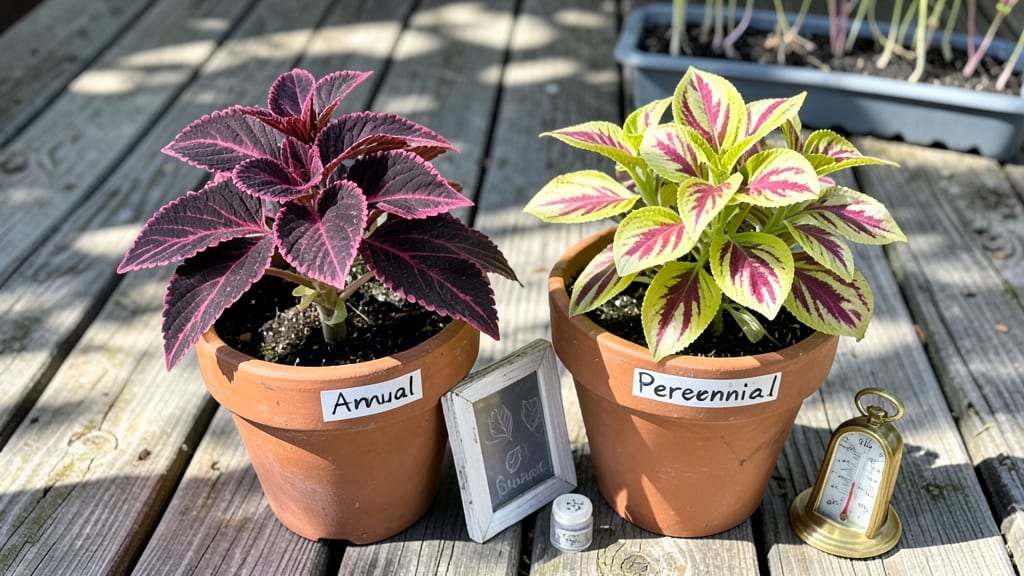
Whether coleus is annual or perennial depends on your climate: it dies back completely in cold winters but regrows from roots in frost-free zones. This frost-tender plant acts like a perennial only when protected from freezing temperatures.
This behavior comes down to coleus's tropical origins—it evolved in warm regions where frost never occurs. 🌱 In colder climates, the plant's above-ground growth freezes, but its tuberous roots often survive underground, ready to sprout again if conditions warm up.
The key difference between annual and perennial behavior lies in how you care for it during winter: while true perennials handle frost naturally, coleus needs human intervention to survive multiple growing seasons.
For gardeners in colder zones, this means coleus can be treated as a short-lived perennial with proper overwintering techniques. Many growers dig up tubers before the first frost and store them indoors, effectively extending the plant's lifespan beyond one season.
The trade-off? Without these steps, coleus will behave like an annual, completing its life cycle each year when temperatures drop.
💡 In This Article
- Why Coleus Dies Back in Winter (Science of Its Life Cycle)
- How to Overwinter Coleus for Year-Round Growth
Why coleus dies back in winter (science of its life cycle)
Coleus enters dormancy because its tropical biology can't tolerate freezing temperatures. When nighttime temps drop below 40°F, the plant's leaves begin to yellow and crisp—this is its natural response to stress.
Unlike true perennials (like hostas or daylilies), coleus lacks cold-hardy adaptations such as deep root systems or insulating ground cover. Its energy shifts underground to preserve the tuberous roots, which contain stored nutrients and growth hormones.
The tuberous roots act like a biological battery—storing starches and sugars during the growing season to fuel regrowth when conditions improve. In frost-free zones (USDA zones 10-12), these roots remain active year-round, allowing coleus to behave as a perennial.
But in colder zones (7-9), the roots enter a semi-dormant state, waiting for warmth. The key difference? True perennials like heuchera or salvia can withstand -10°F to -20°F with minimal protection, while coleus roots typically die if exposed to 25°F for more than 24 hours.
What most gardeners don't realize is that coleus's dieback isn't always permanent. Even in cold climates, if roots survive, they'll sprout new shoots when soil temps reach 60°F in spring.
The challenge is protecting those roots from freezing—mulching with 6-8 inches of straw or leaves can raise soil temps by 5-10°F, making the difference between survival and death. 🌡️ This explains why some gardeners in zone 7 see coleus resprout naturally while others don't.
Another critical factor is coleus's growth habit. Unlike woody perennials, coleus is a herbaceous plant with soft stems that can't withstand frost. Its leaves contain high water content (65-75% by weight), which freezes and ruptures cell walls at 32°F.
This is why you'll see blackened, mushy foliage after a hard freeze—it's not just wilting, but actual cellular damage. The roots, however, remain protected by the insulating soil, which explains why some plants "come back" the following season.
For comparison, consider caladiums (elephant ears), which share coleus's tropical origins and tuberous roots. Both plants die back in winter, but caladiums are more cold-sensitive, requiring 65°F soil to regrow, while coleus can sprout at 55°F.
This slight difference in temperature tolerance affects overwintering strategies—coleus is more forgiving in marginal climates where caladiums would fail.
Here's what's actually happening at the cellular level: When temperatures drop, coleus triggers a cascade of hormonal changes. Auxin (growth hormone) levels plummet, while abscisic acid (stress hormone) spikes, causing leaves to abscise (drop off). Meanwhile, the roots convert stored sugars into antifreeze proteins—similar to how woody plants survive winter.
The difference? Coleus's antifreeze proteins are less effective than those in true perennials, which is why it needs human intervention to survive cold winters.