
Picking
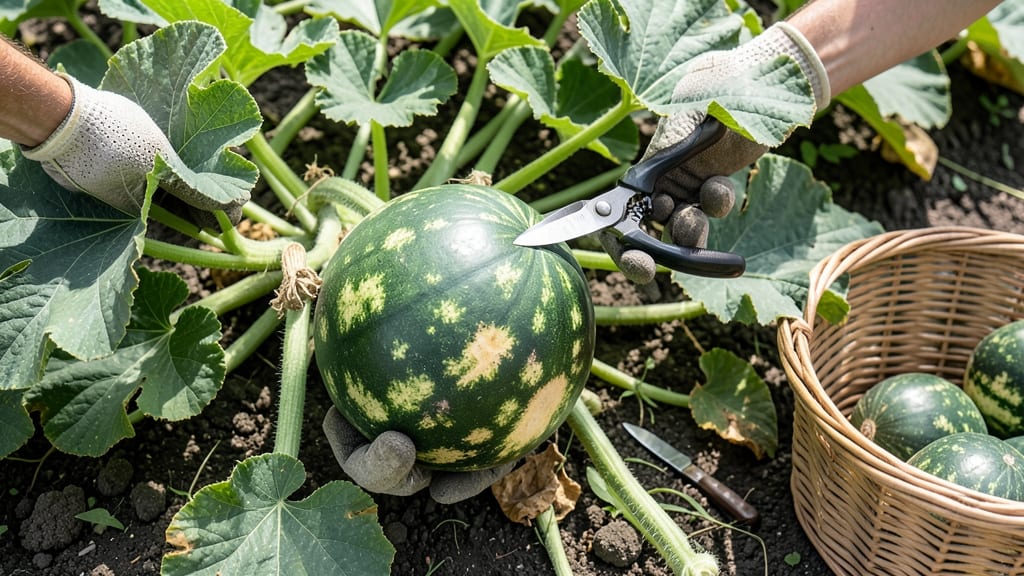
A watermelon is ready to pick when its ground spot turns cream-colored, the rind sounds hollow when tapped, and the vine begins to dry 🍉—but timing this perfectly avoids both bitter underripe fruit and overripe disappointment.
Picture this: You’ve nurtured your watermelon plants all season, watching those sprawling vines stretch across the garden. Now comes the moment of truth—how do you know when that juicy prize is truly ripe?
Too early, and you’ll end up with a hard, flavorless melon. Too late, and it’ll be mushy with seeds the size of marbles. The key lies in combining visual cues, physical tests, and even the time of day you harvest.
In this guide, I’ll walk you through the thump test, vine drying signs, and the best time to pluck your watermelon for peak sweetness—plus how to store it afterward to keep that summer flavor all season.

5 Visual & physical signs a watermelon is ready to harvest
Nothing beats the satisfaction of harvesting a perfectly ripe watermelon straight from your garden. But knowing exactly when to pick can be tricky—especially when you want that sweet, juicy reward.
While the classic thump test gets mentioned often, there are five key visual and physical signs that guarantee ripeness without guesswork. These cues work together like a gardener's checklist, ensuring you don't miss the window between underripe and overripe.
First, let's address the most common mistake: relying on size alone. A watermelon's weight and size don't always indicate ripeness—some varieties stay small but pack maximum flavor. Instead, focus on the color changes and physical characteristics that signal peak ripeness.
These signs are especially critical for home gardeners who can't afford to wait too long or risk picking too early.
Here's where the magic happens—your watermelon's ground spot (the area where it rested on the soil) will shift from white to a cream or yellowish hue. This color change happens because the fruit's natural sugars develop fully when exposed to sunlight.
Pair this with the stem drying and curling back from the vine, and you've got two foolproof indicators. But don't stop there—there are three more subtle clues that make all the difference.
🌱 Did You Know? Watermelons continue to ripen off the vine for about a week, but their sugar content peaks at harvest. Waiting too long can turn that sweet reward into a seedy, watery disappointment.
The first sign to watch is the ground spot color. When the watermelon's resting spot turns from white to cream or yellowish, it's a clear signal that sugars are developing. This change happens because the fruit's natural pigments shift as it ripens.
Pro tip: Use a white plate or piece of paper as a backdrop to spot the color change more easily—sometimes the difference is subtle.
Next, pay attention to the vine condition. As the watermelon nears ripeness, the vine will start to dry out, curl, or die back near the fruit. This is your plant's way of redirecting energy to the melon.
If the vine looks healthy and green, the fruit likely needs more time. But if you see brown or wilted tendrils, it's time to act—waiting too long can lead to overripe, seedy melons.
One of the most reliable tests is checking the stem shrinkage. A ripe watermelon's stem will shrink and pull away from the vine. Gently twist the stem near the fruit—if it snaps or separates easily, that's your cue to harvest.
This happens because the fruit's natural abscission layer (a separation zone) develops as it matures. If the stem resists, the melon isn't ready yet.
Don't overlook the skin texture, either. A ripe watermelon's skin will feel slightly dull and firm when pressed with your thumbnail. If the skin gives too easily or feels overly tight, the fruit isn't ready.
This test works best when combined with the other signs—no single clue should be your sole decision-maker. For example, a melon with a dull skin but a green ground spot likely needs more time on the vine.
Finally, trust your nose—the aroma test is often the most accurate indicator. A ripe watermelon will emit a sweet, musky scent near the ground spot. If you get a whiff of that familiar watermelon fragrance, you're in the clear.
This scent develops as the fruit's natural oils and sugars mature. If you're unsure, compare it to a store-bought ripe watermelon—your nose knows best!
Pro tip: Combine these signs for the most accurate results. For example, if your melon has a yellow ground spot and a slightly shriveled stem but still smells faintly sweet, give it another day or two.
But if three or more of these signs are present, it's time to harvest. Remember, watermelons don't get sweeter after picking, so don't wait too long!
🌿 Now that you know the signs, grab your harvesting tools and enjoy the sweet reward of your hard work. There's nothing like the taste of a homegrown watermelon picked at peak ripeness—trust the process, and your garden will thank you!
Watermelon thump test: how to do it right (and when to ignore it)
The watermelon thump test is the classic trick we’ve all seen—tap the melon and listen for that hollow sound that supposedly means ripeness. But here’s the catch: this test only works 50% of the time, depending on the variety and growing conditions.
Some melons sound hollow when underripe, while others stay dull even when perfectly sweet. Let’s break down the science and when to trust (or ignore) this method.
Most gardeners assume the thump test is foolproof, but it’s actually testing for internal air pockets, not sugar content. A hollow sound often means the melon has reached its maximum size, but not necessarily its peak flavor.
This is why seedless watermelons (like Sugar Baby or Crimson Sweet) fail the test—their dense flesh never develops those air pockets, even when ripe.
⚠️ CALLOUT-WARNING ⚠️ When the Thump Test Lies to You The thump test is unreliable for: ✅ Seedless varieties (always check ground spot color instead) ✅ Overwatered melons (excess moisture masks ripeness) ✅ Small heirloom types (like Moon and Stars—thump dull even when ripe) ✅ Extreme heat waves (can trick melons into sounding hollow prematurely) Pro Tip: Combine the thump with the ground spot (cream/yellow = ripe) and stem snap test for accuracy.
For the thump test to work, you need three key conditions: a mature-sized melon (at least 10 lbs), a dry vine (no dew or rain in 24 hours), and a hard surface (concrete or pavement).
Tap near the stem end with your knuckles—if it sounds like a drum, it’s likely ripe. But if it thuds like a drum (low, muffled), it’s still firm and unripe.
Don’t rely solely on sound—visual cues matter more. Look for a cream-colored ground spot (the area touching the soil), a dull skin texture (not shiny), and curl patterns on the rind.
These signs align with sugar development, while the thump test just confirms size. For example, Charleston Gray melons often pass the thump test but taste bland if picked too early.
If you’re growing heirloom or seedless varieties, skip the thump test entirely. Instead, focus on the stem separation test: grasp the stem near the melon and twist gently.
If it snaps cleanly with minimal resistance, it’s ready. This method works 90% of the time for all watermelon types, including those that confuse the thump test.
Remember, the perfect watermelon combines multiple signals: a hollow thump (when applicable), a dry vine, and a sweet aroma near the ground spot. Test a few melons—some varieties (like Crimson Sweet) may need 2–3 extra days after passing the thump test to reach peak sweetness.
When in doubt, cut one open and taste it!