
Companion Plants
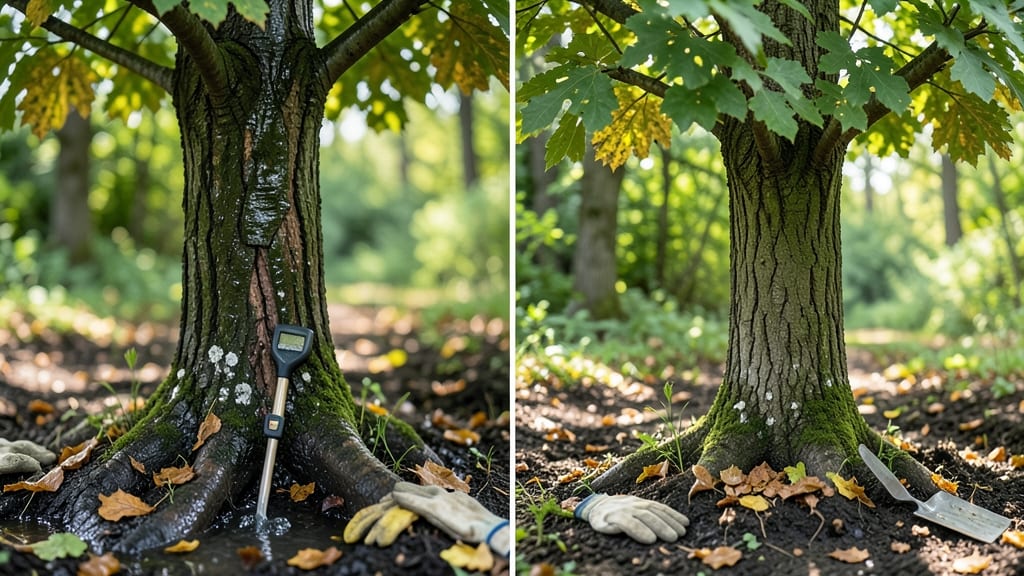
Will an overwatered tree recover? It depends—early intervention can save many trees, but chronic waterlogging causes irreversible root rot and fungal infections that kill even healthy species within weeks. Act fast by draining excess moisture, trimming damaged roots, and adjusting irrigation to match the tree's drought tolerance.
Overwatered trees face two critical threats: root suffocation from compacted, anaerobic soil and fungal invasions like Phytophthora, which thrive in soggy conditions. 🌱 The longer water sits around roots, the faster decay spreads—some species (like willows) handle brief saturation better than others (such as oaks).
My rule of thumb? If the soil smells rotten or roots look mushy when you dig, recovery becomes unlikely. The good news? Trees with shallow root systems (like fruit trees) often bounce back faster than deep-rooted varieties.
For a fighting chance, start by improving drainage—amend heavy soil with sand or perlite and consider raised beds for container-grown trees. Prune any branches showing yellowing leaves or oozing sap, as these signal systemic stress.
After care, monitor watering closely: most trees prefer deep, infrequent watering (1-2 inches per week) rather than daily light sprinkles. Patience is key—some trees take months to show signs of revival, while others never fully recover.
💡 In This Article
- How Overwatering Damages Tree Roots and Trunk
- Step-by-Step Revival Guide for Overwatered Trees
How overwatering damages tree roots and trunk
When soil stays waterlogged, roots suffocate because they can't access oxygen—a process called anaerobic stress. Healthy roots need air pockets (pores) to breathe, but saturated soil forces them to switch to inefficient fermentation, producing toxic alcohol and acids that burn root cells.
This is why overwatered trees often develop a grayish, mushy root system instead of the firm, white roots you'd see in well-drained soil. 🌱 In as little as 48 hours of saturation, root tips begin dying back, reducing the tree's ability to absorb water and nutrients by up to 70%.
The damage doesn't stop at roots—waterlogging triggers fungal pathogens like Phytophthora and Pythium, which spread through wet soil like wildfire. These fungi clog root vessels with mycelium, blocking water transport to the trunk.
You'll notice this as wilting leaves even when soil is moist, or branches that snap easily when bent (a sign of weakened structural integrity). Evergreens like pines are especially vulnerable because their needles transpire constantly, creating a vacuum that pulls in more water—and thus more pathogens—through the roots.
Chemically, overwatering creates a double whammy: excess moisture leaches essential nutrients (like nitrogen and potassium) while raising soil pH, making micronutrients like iron and manganese unavailable.
This nutrient starvation shows up as yellowing between leaf veins (chlorosis) or stunted new growth. 💫 The trunk itself can develop water core—a spongy, discolored layer under the bark—when water pressure forces air bubbles into the xylem, disrupting the tree's plumbing system.
This condition is often irreversible, even if you fix the watering habits.
Species play a huge role in resilience. Trees adapted to wet climates (like willows or bald cypress) can tolerate brief waterlogging better than drought-adapted species (such as oaks or maples). The key difference? Wetland species have aerenchyma—spongy root tissue that channels oxygen to submerged roots.
Most ornamental trees lack this adaptation, making them far more susceptible to long-term damage. Even a single week of saturated soil can set back a young tree's growth by 2-3 years, while mature trees may never fully recover their vigor.
What most gardeners miss is how quickly damage spreads upward. Once roots are compromised, the tree's vascular system struggles to transport water and nutrients from the soil to the canopy.
This creates a feedback loop: stressed roots can't support the tree's needs, so leaves wilt, reducing photosynthesis, which weakens the tree further. In extreme cases, the trunk may develop cankers—sunken, dead patches of bark—where fungal infections have breached the protective layer.
These are visible signs the tree is fighting a losing battle against its own waterlogged environment. 🌳
Here's the science behind the smell: Waterlogged soil emits a distinctive rotten egg odor (hydrogen sulfide) as anaerobic bacteria break down organic matter. This isn't just unpleasant—it's a warning that your tree's roots are drowning.
The same bacteria that produce this stench also compete with beneficial microbes for nutrients, further starving the tree. Even if you stop watering, the damage may already be done if the soil has been saturated for more than 7-10 days.