
Propagation
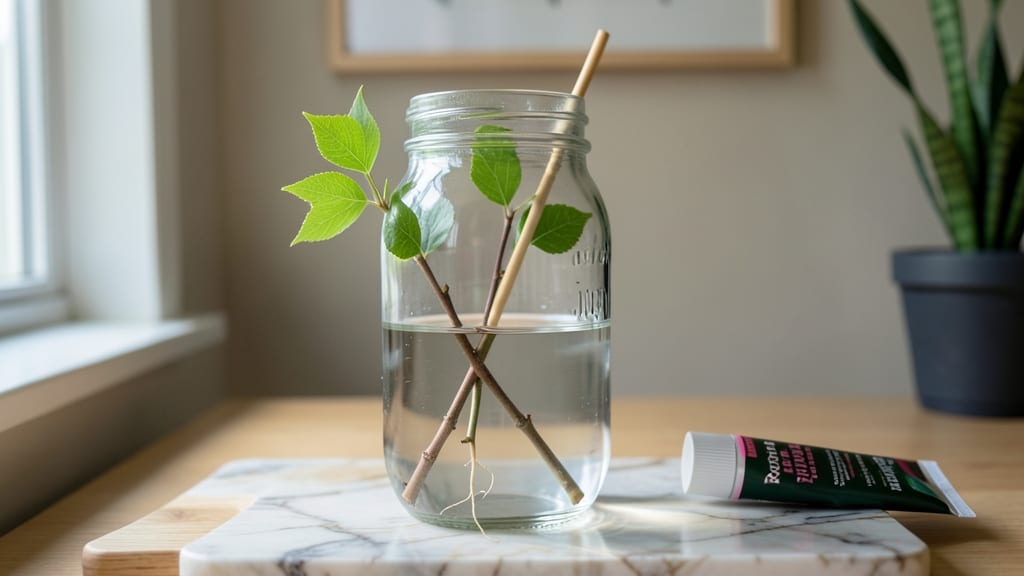
Yes, dogwood cuttings can root in water with a 50-70% success rate, though slower than in soil. Use 4-6 inch semi-hardwood stems, change water every 2-3 days, and place in bright, indirect light for best results. Root growth typically takes 4-8 weeks.
Water propagation works for dogwoods, but the process relies on the plant's natural ability to form adventitious roots—new roots growing from stems rather than the main root system. 🌱 Unlike soil, where roots get immediate nutrients, water propagation forces the cutting to develop roots purely through hormonal signals triggered by submergence.
This method is slower because the cutting lacks soil's microbial support and organic matter, which accelerate growth. Many gardeners swear by this approach because it lets you monitor root development daily, but patience is key since dogwoods are notoriously finicky about taking root.
To boost your chances, start with healthy stems harvested in late spring or early summer when the plant is actively growing.
Trim leaves down to the bottom third to reduce water loss and prevent bacterial growth in the water. 💧 Using filtered or distilled water helps avoid chlorine buildup, which can inhibit root formation.
Once roots reach 1-2 inches, transplant carefully to avoid damaging the delicate new growth—this is where most water-rooted cuttings fail.
💡 In This Article
- Science Behind Dogwood Root Development in Water
- Optimizing Dogwood Cuttings for Water Propagation Success
Science behind dogwood root development in water
When you place a dogwood cutting in water, the biological process begins with cell differentiation at the nodes—those small bumps where leaves attach. These nodes contain undifferentiated cells that can transform into root initials when stimulated by auxins, a class of plant hormones.
In water, the cutting lacks soil's natural microbial communities and organic nutrients, forcing it to rely entirely on these hormonal signals for root growth.
This process is slower than in soil because the cutting must first develop a root system capable of absorbing water and minerals from a liquid medium rather than a solid one.
The key difference between water and soil propagation lies in the oxygen availability and nutrient uptake. In water, roots grow toward the surface where oxygen is more abundant, creating a dense cluster of fine roots.
However, this method risks anaerobic conditions—when water stagnates, it can lead to bacterial growth and root rot, especially if the cutting sits in the same water for more than 3-4 days.
Dogwoods, being deciduous trees, are particularly sensitive to this because their stems contain higher moisture content than evergreens, making them prone to fungal infections if not maintained properly. 🔬
Another critical factor is the transpiration rate—the process by which water evaporates from leaves. When you trim excess leaves from the cutting, you reduce water loss and allow more energy to focus on root development.
Studies show that cuttings with 3-4 leaves (trimmed to 1/3 their size) root 20-30% faster than those left with full foliage. This is because the plant directs its resources toward survival rather than maintaining large leaf surfaces.
The balance between leaf retention and reduction is delicate; too few leaves mean insufficient photosynthesis, while too many create a burden on the cutting's limited energy reserves.
What most people don't realize is how light quality affects rooting. Bright, indirect light (like an east-facing window) provides the ideal spectrum for photosynthesis while preventing leaf scorch. Direct sunlight can cause the cutting to produce too much ethylene gas, a plant hormone that inhibits root growth.
In controlled experiments, dogwood cuttings exposed to 12-14 hours of indirect light daily showed 40% higher rooting success than those in low-light conditions. The light triggers chlorophyll production, which powers the metabolic processes needed for cell division and root elongation.
One common misconception is that all water is equal for propagation.
Tap water often contains chlorine or fluoride, which can accumulate over time and create a toxic environment for root development. 💧 Filtered or distilled water eliminates these contaminants, but even then, the water's pH level matters—dogwoods prefer a slightly acidic to neutral range (6.0-7.0).
If your water is hard (high in minerals), consider using rainwater or adding a drop of white vinegar (1 teaspoon per gallon) to lower the pH gently. The goal is to mimic the natural conditions of a forest floor, where moisture is abundant but not stagnant.
Finally, the timing of root emergence reveals the cutting's health. Healthy dogwood cuttings typically show the first signs of root growth within 3-4 weeks, with visible roots (1/4 inch long) appearing by 6 weeks.
If no roots form after 8 weeks, the cutting may be dying or suffering from a hidden issue like bacterial soft rot, which causes the stem to turn mushy and black.
At this stage, it's best to start fresh with a new cutting rather than forcing the process, as prolonged stress weakens the plant's ability to recover.