
Flowers
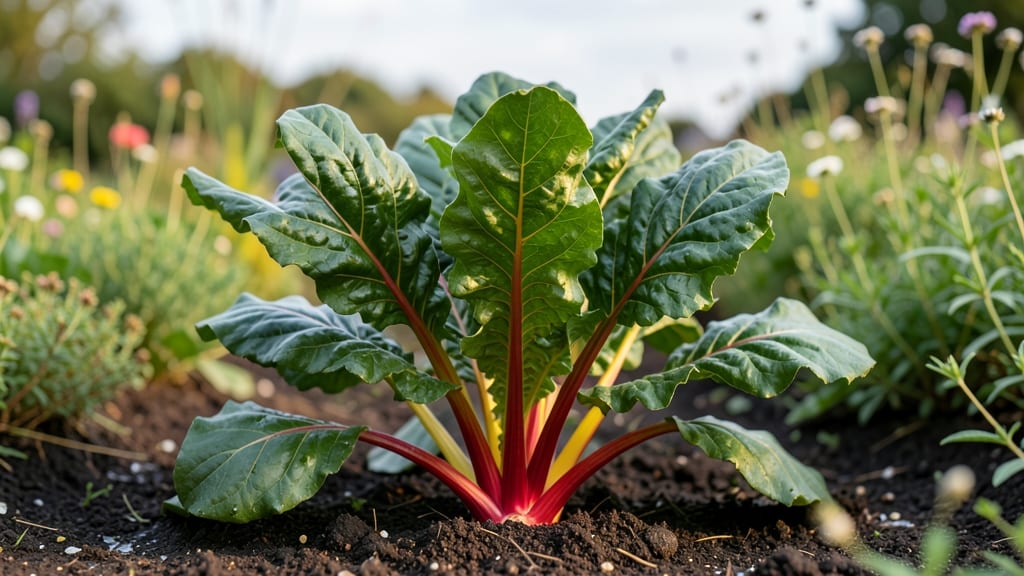
Swiss chard behaves as a perennial in frost-free zones but acts like a biennial in colder climates, completing its life cycle over two years when exposed to winter chill.
This leafy green's behavior depends entirely on your climate zone.
In mild regions where winter temperatures stay above 20°F, Swiss chard happily regrows each spring from its root crown, producing leaves for multiple seasons. 🌱 However, when frost hits, the plant's growth slows dramatically—it won't survive prolonged freezing but may rebloom the following year if the roots remain intact.
The key difference lies in how cold it gets: true perennials thrive through -10°F winters, while Swiss chard typically needs protection below 25°F.
What makes this interesting is how gardeners can manipulate Swiss chard's growth cycle. In colder zones, many treat it as an annual for convenience, but with proper mulching (using straw or leaves) and row covers, you can extend its life through winter.
The plant's ability to regenerate from its base means even if the tops die back, the roots often survive to produce new growth in spring.
💡 In This Article
- Swiss Chard’s Perennial Nature Explained
- Extending Swiss Chard’s Lifespan in Cold Climates
Swiss chard’s perennial nature explained
Swiss chard behaves as a true perennial only in frost-free zones where winter temperatures rarely drop below 20°F. In these conditions, its thick, fibrous roots store energy throughout winter, allowing the plant to regrow leaves each spring without replanting.
The key mechanism here is the plant's ability to enter a dormant state—its above-ground growth slows dramatically, but the root crown remains alive, ready to push new shoots when temperatures rise.
This is why you'll see Swiss chard thriving year after year in Mediterranean climates or coastal regions with mild winters.
The botanical distinction lies in how Swiss chard responds to cold. Unlike true perennials (like asparagus or rhubarb) that survive -10°F winters, Swiss chard's tolerance tops out around 25°F. Below this threshold, its cells begin to freeze, and prolonged exposure kills the plant.
What's fascinating is how this cold sensitivity triggers its biennial behavior in colder climates. When exposed to winter chill, Swiss chard shifts into reproductive mode, producing flowers and seeds in its second year—a classic biennial growth pattern.
This explains why gardeners in Zone 5 or colder often treat it as an annual for simplicity.
Here's what happens under the surface: Swiss chard's root system contains specialized cells called parenchyma that store starches and sugars. These act like a natural battery, fueling regrowth when conditions improve.
In frost-free zones, this cycle repeats annually, while in colder areas, the roots may survive one winter but weaken over time without protection. The plant's ability to regenerate from its base—even after frost damage—makes it uniquely resilient compared to other leafy greens that bolt or die completely in winter.
Consider this comparison: In Zone 9 (mild winters), Swiss chard might produce harvestable leaves for 12+ months with minimal care. In Zone 6 (colder winters), the same plant would likely die back in winter but might resprout in spring if the roots survive.
The difference comes down to degree days below freezing—a measure of cold exposure that determines whether the plant's root system can endure. This is why gardeners in transitional zones often use row covers or cold frames to extend the growing season.
What most people don't realize is how Swiss chard's growth habit changes with temperature. Studies show that when nighttime temperatures drop below 50°F, the plant shifts energy from leaf production to root development—a survival strategy that explains why it often looks "tired" in fall.
This physiological response is similar to how other biennials prepare for winter, but Swiss chard's flexibility means it can revert to perennial behavior when conditions allow. The result? A plant that blurs the line between annual, biennial, and perennial depending entirely on climate.
For gardeners, this means Swiss chard offers a rare opportunity to experiment with growing cycles. In mild climates, you can harvest continuously for years with proper care.
In colder areas, treating it as a biennial might yield better results—planting fresh seeds each spring while letting the previous year's roots decompose naturally.
The plant's adaptability makes it one of the most forgiving leafy greens for home gardeners, whether you're in a frost-free paradise or a zone with harsh winters. 🌿