
Watering
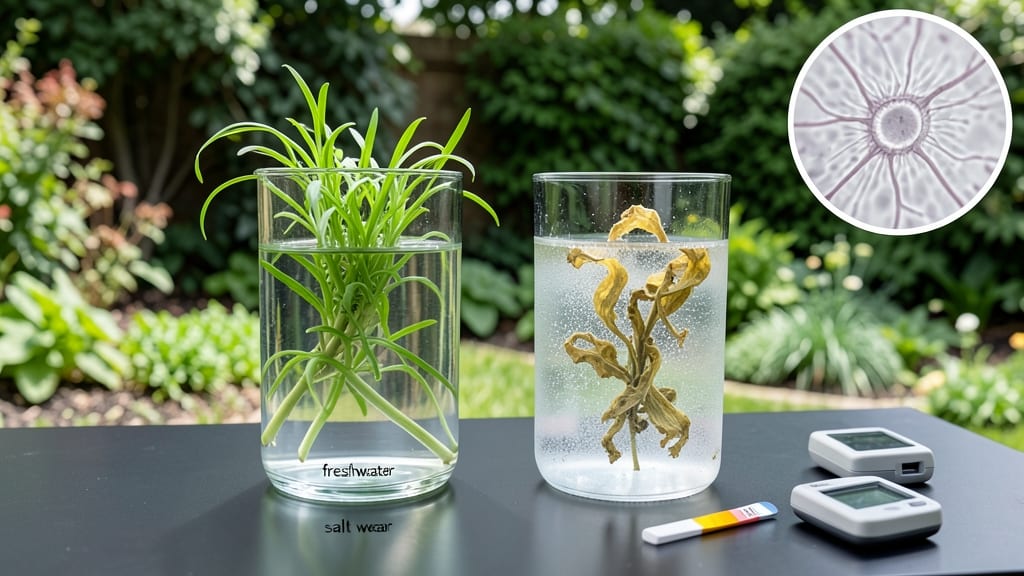
What happens when you put a plant cell in salt water triggers osmosis, forcing water out through the membrane and causing plasmolysis—the cell membrane detaches from the rigid cell wall. This disrupts cellular processes and can eventually kill the plant.
Saltwater creates a hypertonic environment where water rushes out of the cell to balance the concentration difference. 🌱 This process, called plasmolysis, causes the cell membrane to pull away from the cell wall, collapsing the plant's structural integrity.
In gardening, this explains why over-salting soil or using tap water with high mineral content can stunt plant growth—even if the soil appears moist.
What makes this especially damaging is how quickly it happens. Within minutes, affected cells lose turgor pressure, the internal water pressure that keeps stems rigid and leaves upright. 💧 Over time, this leads to wilting, yellowing leaves, and stunted roots.
The good news? Most plants can recover if you flush the soil with fresh water immediately and adjust your watering practices.
💡 In This Article
- The Science of Osmosis in Plant Cells
- Real-Life Effects on Houseplants and Gardening
The science of osmosis in plant cells
When you immerse a plant cell in salt water, the real action happens at the microscopic level where osmosis takes over. The cell membrane acts like a semi-permeable filter, allowing water molecules to pass but blocking the larger salt ions.
Inside the cell, the cytoplasm has a lower salt concentration than the surrounding salt water—this creates a concentration gradient that pulls water out of the cell to "balance" the difference. 🔥 The process relies on specialized proteins called aquaporins, which act as water channels, accelerating the movement.
This water loss causes the cell membrane to detach from the rigid cell wall—a condition called plasmolysis. Normally, plant cells maintain turgor pressure (around 5-10 atmospheres in healthy plants) that keeps stems upright and leaves firm.
When water exits, that pressure drops dramatically, causing the membrane to collapse inward like a deflating balloon. 💧 What's fascinating is how quickly this happens: in some plants, visible wilting can occur within 10-15 minutes of saltwater exposure.
The damage goes beyond just appearance. Cellular processes like photosynthesis and nutrient transport rely on proper turgor pressure. When plasmolysis occurs, the cell's internal machinery gets disrupted—chloroplasts (where photosynthesis happens) may even rupture under extreme conditions.
This explains why plants exposed to saltwater often show brown, crispy leaf edges first—the cells along the edges are most vulnerable to osmotic shock.
Saltwater's impact varies by plant type. Succulents, which naturally store water in their cells, show visible plasmolysis at salt concentrations as low as 0.5% salinity. In contrast, salt-tolerant plants like mangroves have specialized cells that can handle up to 3% salinity without immediate damage.
The key difference lies in their cell wall composition and ability to regulate internal salt levels through compartmentalization.
Here's what's actually happening chemically: The sodium and chloride ions from salt dissociate in water, creating a hypertonic solution. The cell's internal water potential (measured in megapascals) drops below the external environment's potential, forcing water out.
This gradient can reach a difference of 1.5 MPa or more in severe cases, creating an unstoppable osmotic flow until equilibrium is reached—or the cell dies from dehydration.
What most gardeners don't realize is how easily this happens in everyday conditions. Even "fresh" tap water can contain enough dissolved minerals to create mild osmotic stress over time.
That's why plants often thrive better with rainwater or distilled water—they lack the extra solutes that gradually build up in soil and affect cell function.