
Watering
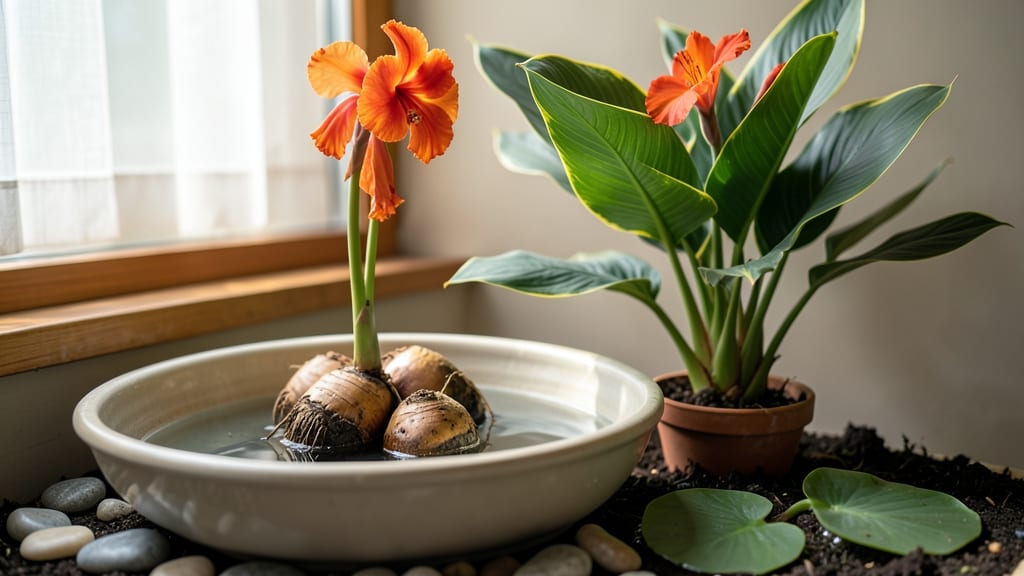
Canna lilies can grow in water through hydroponic setups, thriving when their roots are submerged in 4-6 inches of nutrient-rich water with adequate lighting and structural support.
This aquatic adaptation works because canna lilies naturally develop aerenchyma—air-filled root tissues—that help them absorb oxygen even underwater. 🌿 Unlike traditional soil-grown plants, water-grown cannas rely on dissolved nutrients, so you'll need a balanced hydroponic solution (like diluted fish emulsion or seaweed extract) to prevent deficiencies.
The key difference is their ability to photosynthesize efficiently in water, though they still require bright, indirect light for at least 6 hours daily to maintain vibrant blooms.
For best results, use a wide-mouth container (like a bucket or grow bag) with drainage holes to prevent root rot, and add floating plants (such as water hyacinths) to improve oxygen levels.
Prune yellowed leaves regularly to redirect energy to flowering—water-grown cannas often produce larger, more dramatic blooms than their soil counterparts when given proper care.
💡 In This Article
- Root Adaptations: How Canna Lilies Thrive in Aquatic Environments
- Hydroponic Canna Lily Care: Lighting, Nutrients, and Container Essentials
Root adaptations: how canna lilies thrive in aquatic environments
Canna lilies possess a remarkable biological adaptation called aerenchyma, which is a spongy, air-filled tissue in their roots.
This specialized structure allows them to absorb oxygen directly from water, much like aquatic plants such as lotus or water hyacinths. 🌿 When submerged, these air channels create a pathway for oxygen to reach the root system, preventing suffocation that would otherwise occur in waterlogged soil.
The roots also develop a network of fine, fibrous extensions that maximize surface area for nutrient absorption, compensating for the limited mobility of dissolved minerals compared to soil.
The transition from soil to water affects how cannas uptake nutrients. In soil, roots rely on capillary action and microbial activity to access minerals, but in water, they must depend on dissolved nutrients like nitrogen, phosphorus, and potassium.
This is why hydroponic solutions—often containing chelated iron and micronutrients—are essential for water-grown cannas. Interestingly, submerged roots also produce more ethylene gas, a plant hormone that triggers flowering, which explains why aquatic cannas often bloom more prolifically than their terrestrial counterparts.
Light plays a critical role in this adaptation. Canna lilies are heliophytes, meaning they thrive in bright light, but their underwater growth requires indirect sunlight or artificial grow lights to prevent leaf scorch.
The leaves develop a slightly waxier coating in water to reduce water loss, though they remain less glossy than fully aquatic plants. 💫 When grown in water, cannas also exhibit slower vertical growth but compensate with broader, more robust foliage to maximize photosynthesis.
This trade-off highlights their evolutionary flexibility in adapting to different environments.
One fascinating aspect of water-grown cannas is their root morphology. Unlike soil-grown plants, which develop deep taproots, aquatic cannas form a dense mat of shallow, horizontal roots. This structure stabilizes the plant in water and allows it to anchor to containers or natural substrates like rocks.
The roots also secrete mucus-like substances that help trap fine particles and organic matter, mimicking the nutrient-capture strategies of aquatic plants. This adaptation is particularly useful in hydroponic setups where nutrient solutions can be less concentrated.
Flowering behavior also shifts in water-grown cannas. The reduced oxygen levels in stagnant water can delay blooming, but with proper aeration and nutrient balance, they often produce larger, more vibrant flowers due to increased energy allocation toward reproductive structures.
The flowers themselves may exhibit slightly different color intensities, with red and orange hues appearing more vivid in water due to enhanced anthocyanin production—a natural response to stress and nutrient availability.
For gardeners experimenting with aquatic cannas, understanding these adaptations is key. The ability to thrive in water makes them an excellent candidate for semi-hydroponic setups, where the base of the plant is submerged while the foliage remains above water.
This hybrid approach reduces the risk of root rot while still allowing the plant to benefit from the unique nutrient dynamics of water cultivation. 🌸